
Past Paper Download
Preparing for the Punjab Public Service Commission (PPSC) Deputy Accountant BS-16 examination requires more than memorizing general knowledge questions. Candidates should understand the advertised syllabus, practise relevant accounting concepts, and use reliable study materials.
This guide explains how to verify the examination pattern, prepare for the major accounting topics, practise MCQs, and find past-paper resources. Always use the latest official advertisement and syllabus for the specific recruitment cycle you are applying for.
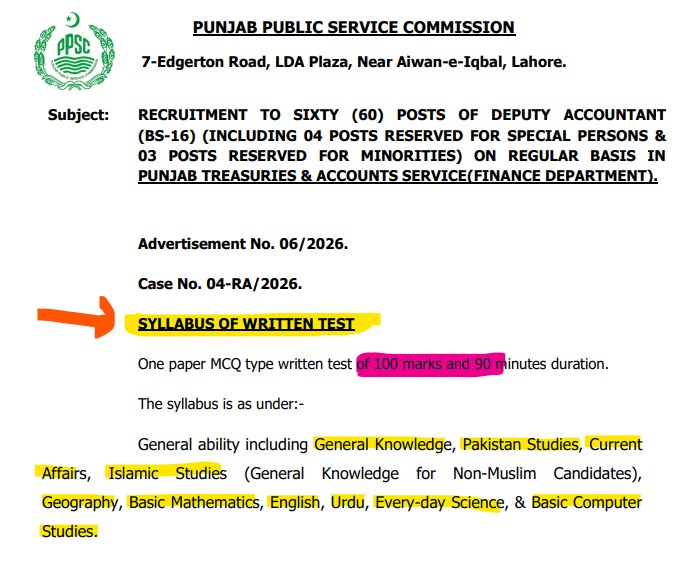
PPSC Deputy Accountant Exam Pattern
The exact paper structure, duration, subject distribution, marking rules, and qualifying criteria should be confirmed from the relevant PPSC advertisement and examination instructions.
Before preparing your study timetable, verify the following details:
| Examination detail | Information to verify |
|---|---|
| Post title and scale | Deputy Accountant, BS-16, as stated in the advertisement |
| Examination format | Written examination or screening test format |
| Total questions and marks | Check the official paper instructions |
| Examination duration | Confirm the time allowed |
| Subject distribution | Follow the advertised syllabus |
| Negative marking | Check the applicable examination rules |
| Passing criteria | Refer to the relevant official instructions |
| Calculator policy | Check the instructions issued for the examination |
Official source: Visit the Punjab Public Service Commission website and locate the advertisement and syllabus for the relevant post. Do not rely on an old advertisement if a newer recruitment notice applies to your examination.
How to Prepare for the Accounting Portion
Accounting knowledge is an important part of preparation for an accounting-related position. The topics below are useful areas to review, but they should not be treated as the confirmed official syllabus unless they appear in the relevant PPSC notice.
1. Financial Accounting
Revise the accounting cycle, journal entries, ledger posting, trial balance, adjusting entries, and preparation of financial statements.
Practise these concepts:
- Double-entry bookkeeping
- Bank reconciliation statements
- Depreciation calculations
- Inventory valuation
- Accruals and prepayments
- Income statements and balance sheets
Practice example: A business has an unadjusted cash-book bank balance of Rs. 50,000. A cheque issued but not yet presented is Rs. 8,000. Work through the bank reconciliation and explain how the outstanding cheque affects the reconciliation.
Make sure your worked solutions show the calculation steps rather than only the final answer.
2. Cost and Management Accounting
Review the fundamental concepts of cost classification, cost sheets, material and labour costing, overhead allocation, and break-even analysis.
Useful practice areas include:
- Fixed and variable costs
- Contribution per unit
- Break-even point
- Marginal costing
- Budgeting and variance analysis
Practice example: A product sells for Rs. 500 per unit and has a variable cost of Rs. 300 per unit. If total fixed costs are Rs. 100,000, calculate the break-even sales volume.
Solution:
Contribution per unit = Rs. 500 − Rs. 300 = Rs. 200.
Break-even quantity = Rs. 100,000 ÷ Rs. 200 = 500 units.
This type of worked example helps candidates understand how accounting formulas are applied.
3. Auditing
Study the purpose of auditing, internal controls, audit evidence, vouching, verification of assets and liabilities, and the responsibilities of an auditor.
For each concept, prepare:
- A clear definition
- A practical example
- Common MCQ distinctions
- A short revision note
Use the relevant accounting textbooks and syllabus references to check technical terminology and applicable standards.
4. Business Finance and Related Subjects
Where included in the official syllabus, revise financial ratios, working capital management, cash-flow analysis, and basic business law.
Focus on understanding the meaning of each formula, when it is used, and how to interpret the result.
General Knowledge and Computer Preparation
Prepare these subjects according to the officially advertised syllabus rather than assuming that every topic carries a fixed percentage of the examination.
Computer Studies
Practise basic computer terminology, operating systems, file management, cybersecurity fundamentals, and Microsoft Office.
For MS Excel, learn:
- SUM and AVERAGE
- IF and COUNTIF
- Sorting and filtering
- Cell references
- Basic spreadsheet calculations
Pakistan Studies and Current Affairs
Use reliable sources for constitutional history, Pakistan’s major historical events, and current affairs. Record the publication date of current-affairs notes and update them before the examination.
English and General Knowledge
Practise grammar, vocabulary, sentence correction, comprehension, and general knowledge questions relevant to the official syllabus.
Prepare Islamic Studies or Ethics according to the applicable examination instructions.
PPSC Deputy Accountant Past Papers and Practice Resources
Past papers can help candidates understand question styles, identify weak areas, and practise time management. However, a paper should not be described as an official PPSC past paper unless its origin has been verified.
The following third-party pages have been listed as potential resources. Check each page and its downloadable file before relying on it:
- Past paper resource labelled 2025
- Past paper resource labelled 2024
- Past paper resource labelled 2023
- Past paper resource labelled 2022
- Past paper resource labelled 2020
- Past paper resource labelled 22 December 2019
These are external resources, not verified official PPSC downloads. Confirm that each file actually contains the stated examination paper and year. If a resource cannot be verified, remove it or clearly explain what it contains.
Original Practice MCQs
Use the following sample questions to revise basic accounting concepts. These are original practice questions for learning, not questions claimed to have appeared in a PPSC examination.
Question 1: What is the main purpose of a trial balance?
A. To calculate sales tax
B. To check the arithmetical agreement of ledger balances
C. To calculate depreciation only
D. To prepare a bank statement
Correct answer: B. A trial balance lists ledger balances to check whether total debits equal total credits. Agreement does not guarantee that every accounting error has been detected.
Question 2: Which of the following is normally classified as a current asset?
A. Office building held for long-term use
B. Long-term bank loan
C. Inventory held for sale
D. Owner’s capital
Correct answer: C. Inventory held for sale is generally classified as a current asset, subject to the applicable accounting framework.
Question 3: What is the contribution per unit if the selling price is Rs. 800 and the variable cost is Rs. 500?
A. Rs. 200
B. Rs. 300
C. Rs. 500
D. Rs. 1,300
Correct answer: B. Contribution per unit = Selling price − Variable cost = Rs. 800 − Rs. 500 = Rs. 300.
Add more questions with checked answers, explanations, and references before describing this section as a comprehensive practice bank.
How to Build an Effective Study Plan
- Obtain the latest applicable PPSC syllabus.
- Divide the advertised subjects into manageable study sessions.
- Revise accounting concepts and solve numerical questions.
- Practise MCQs and record incorrect answers for revision.
- Take timed mock tests using the actual examination duration and rules.
- Recheck official notices for any changes before the examination.
Frequently Asked Questions
Where can I find the official Deputy Accountant syllabus?
Start with the official PPSC website and locate the relevant advertisement and syllabus. Confirm that the document matches your post and recruitment cycle.
Are third-party past-paper PDFs official?
Not necessarily. Check the original source, paper date, post title, and document contents before treating a file as an authentic past paper.
Is there negative marking in the examination?
Check the instructions for your specific examination. Do not assume a particular penalty applies without official confirmation.
Can I use a calculator during the examination?
Follow the examination instructions issued by PPSC. Do not assume calculators are allowed or prohibited without checking the applicable rules.
Does passing the written examination guarantee an interview?
No. The next stage and shortlisting arrangements depend on the relevant recruitment rules, advertisement, and official instructions.
Final Preparation Advice
A good preparation strategy combines verified syllabus information, clear explanations, numerical practice, and regular revision. Use official notices for recruitment facts and reliable educational references for subject knowledge.
This website provides independent educational guidance to help candidates prepare. Always confirm recruitment requirements and examination instructions with PPSC before making application or examination decisions.
While PPSC sets a standard passing threshold of 40% to technically qualify on the written exam, passing does not guarantee an interview call.
For every single announced vacancy, PPSC typically shortlists the top 5 candidates from the written merit list to appear for the panel interview. The final selection merit ranking is calculated using a cumulative formula out of 200 total marks:
No, PPSC strictly bans all electronic devices, including financial or scientific calculators, requiring all math to be done manually.