

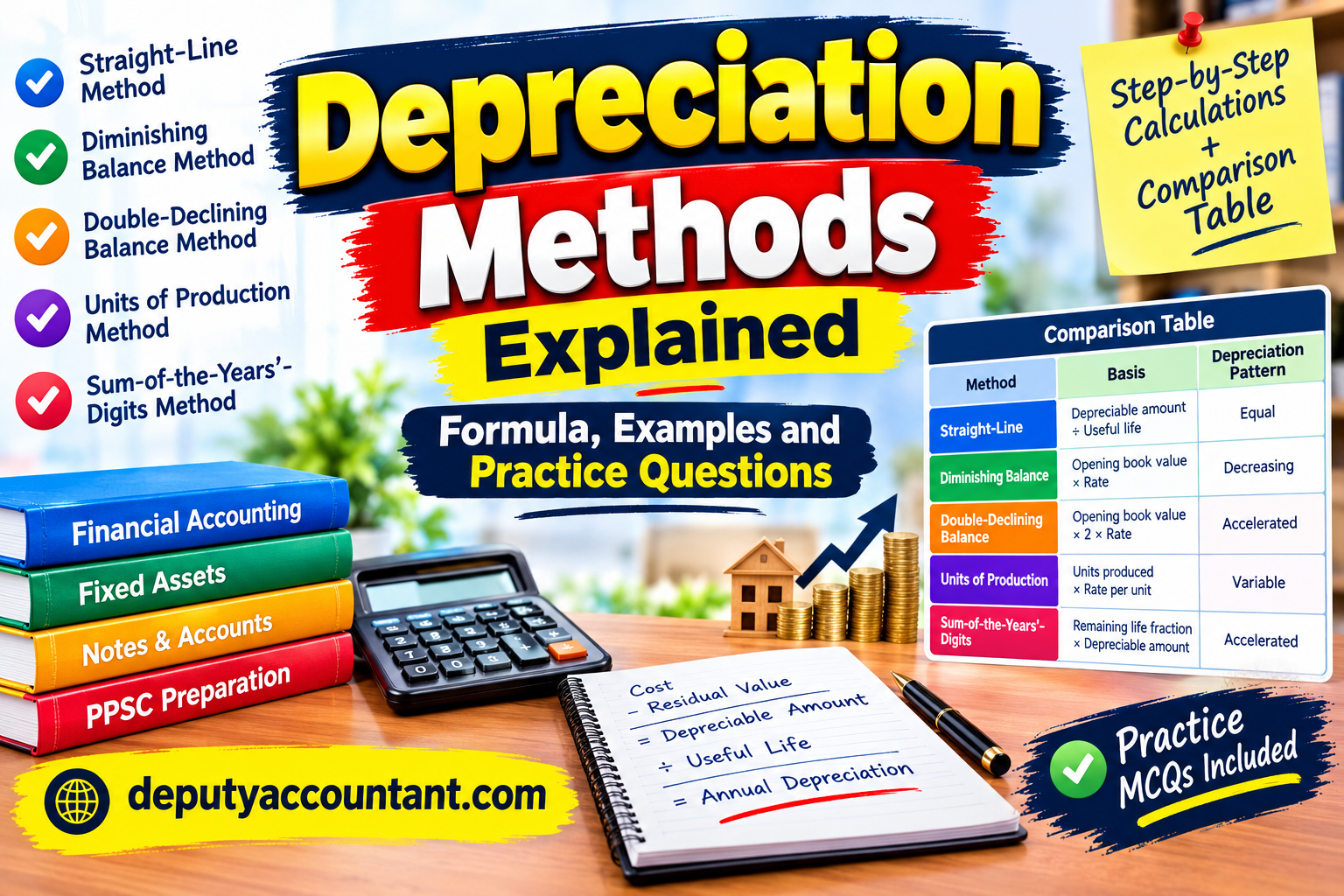
Depreciation is one of the most important topics in financial accounting. It helps businesses allocate the cost of tangible fixed assets over their useful lives instead of charging the entire cost as an expense in the year of purchase.
Understanding depreciation methods is essential for accounting students, commerce examinations, professional accounting studies, and candidates preparing for the PPSC Deputy Accountant test.
In this guide, you will learn the major depreciation methods, their formulas, step-by-step numerical examples, a comparison table, and practice MCQs with answers.
What Is Depreciation in Accounting?
Depreciation is the systematic allocation of the depreciable amount of a tangible asset over its useful life.
Examples of depreciable assets include:
- Buildings used in business operations
- Machinery and production equipment
- Office furniture
- Computers and printers
- Vehicles used by a business
Land generally is not depreciated when it has an unlimited useful life, although certain land improvements and land with a limited useful life may be depreciated.
Important Depreciation Terms
1. Cost of asset: The purchase price plus eligible costs required to bring the asset to the location and condition necessary for its intended use.
2. Residual value: The estimated amount an entity would currently obtain from disposing of an asset at the end of its useful life, after estimated disposal costs.
3. Useful life: The period over which an asset is expected to be available for use, or the expected number of production units it can generate.
4. Depreciable amount: The cost of an asset, or another amount substituted for cost, less its residual value.
5. Accumulated depreciation: The total depreciation charged on an asset up to a particular date.
6. Book value (carrying amount): The asset’s recorded amount after deducting accumulated depreciation and any applicable impairment losses.
Main Methods of Depreciation
The most commonly studied depreciation methods are:
- Straight-Line Method
- Diminishing Balance Method
- Double-Declining Balance Method
- Units of Production Method
- Sum-of-the-Years’-Digits Method
The appropriate method should reflect the expected pattern in which the asset’s future economic benefits are consumed. A business should not choose a method simply because it produces a preferred profit figure.
Read More About: Bank Reconciliation Statement: 5 Solved Examples, Format and Common Mistakes
1. Straight-Line Method of Depreciation
The straight-line method charges an equal amount of depreciation for each full year of an asset’s useful life, assuming its residual value and useful life remain unchanged.
Formula
Annual Depreciation = (Cost of Asset − Residual Value) ÷ Useful Life
Solved Example 1
A company purchases machinery for Rs. 500,000. Its estimated residual value is Rs. 50,000, and its useful life is 5 years. Calculate the annual depreciation using the straight-line method.
Step 1: Identify the information
- Cost of machinery = Rs. 500,000
- Residual value = Rs. 50,000
- Useful life = 5 years
Step 2: Calculate the depreciable amount
Depreciable Amount = Cost − Residual Value
= Rs. 500,000 − Rs. 50,000
= Rs. 450,000
Step 3: Apply the formula
Annual Depreciation = Rs. 450,000 ÷ 5
= Rs. 90,000 per year
Depreciation Schedule
| Year | Depreciation | Closing Book Value |
|---|---|---|
| Purchase | — | Rs. 500,000 |
| Year 1 | Rs. 90,000 | Rs. 410,000 |
| Year 2 | Rs. 90,000 | Rs. 320,000 |
| Year 3 | Rs. 90,000 | Rs. 230,000 |
| Year 4 | Rs. 90,000 | Rs. 140,000 |
| Year 5 | Rs. 90,000 | Rs. 50,000 |
At the end of Year 5, the book value equals the estimated residual value of Rs. 50,000.
When is this method useful?
The straight-line method is appropriate when the asset’s economic benefits are expected to be consumed relatively evenly over its useful life.
2. Diminishing Balance Method of Depreciation
The diminishing balance method, also known as the reducing balance method, calculates depreciation using a fixed percentage of the asset’s opening book value each year.
Because the book value decreases over time, the depreciation expense also decreases.
Formula
Annual Depreciation = Opening Book Value × Depreciation Rate
Solved Example 2
A business purchases equipment for Rs. 200,000. It applies the diminishing balance method at a rate of 20% per year. Calculate depreciation for the first three years.
Year 1
Opening Book Value = Rs. 200,000
Depreciation = Rs. 200,000 × 20%
= Rs. 40,000
Closing Book Value = Rs. 200,000 − Rs. 40,000
= Rs. 160,000
Year 2
Opening Book Value = Rs. 160,000
Depreciation = Rs. 160,000 × 20%
= Rs. 32,000
Closing Book Value = Rs. 160,000 − Rs. 32,000
= Rs. 128,000
Year 3
Opening Book Value = Rs. 128,000
Depreciation = Rs. 128,000 × 20%
= Rs. 25,600
Closing Book Value = Rs. 128,000 − Rs. 25,600
= Rs. 102,400
Depreciation Schedule
| Year | Opening Value | Depreciation (20%) | Closing Value |
|---|---|---|---|
| 1 | Rs. 200,000 | Rs. 40,000 | Rs. 160,000 |
| 2 | Rs. 160,000 | Rs. 32,000 | Rs. 128,000 |
| 3 | Rs. 128,000 | Rs. 25,600 | Rs. 102,400 |
Important: A reducing-balance calculation does not automatically bring an asset’s book value down to its residual value within a fixed number of years. The rate, useful life, residual value, and any final-year adjustment must be considered.
3. Double-Declining Balance Method
The double-declining balance method is an accelerated depreciation method. It uses twice the straight-line depreciation rate and applies that rate to the opening book value.
Formula
Double-Declining Rate = 2 ÷ Useful Life × 100%
Annual Depreciation = Opening Book Value × Double-Declining Rate
Solved Example 3
A machine costs Rs. 300,000, has an estimated useful life of 5 years, and has a residual value of Rs. 30,000. Calculate depreciation for the first two years using the double-declining balance method.
Step 1: Calculate the rate
Straight-line rate = 100% ÷ 5
= 20%
Double-declining rate = 20% × 2
= 40%
Step 2: Calculate Year 1 depreciation
Depreciation = Rs. 300,000 × 40%
= Rs. 120,000
Closing Book Value = Rs. 300,000 − Rs. 120,000
= Rs. 180,000
Step 3: Calculate Year 2 depreciation
Depreciation = Rs. 180,000 × 40%
= Rs. 72,000
Closing Book Value = Rs. 180,000 − Rs. 72,000
= Rs. 108,000
The book value must not be reduced below the estimated residual value. Depreciation in later years may need to be adjusted so that the asset reaches, but does not fall below, its residual value by the end of its useful life.
4. Units of Production Method
The units of production method calculates depreciation based on actual usage or production rather than simply the passage of time.
It is useful for machinery, manufacturing equipment, and other assets whose wear and tear is closely related to output.
Formula
Depreciation per Unit = (Cost − Residual Value) ÷ Estimated Total Units
Depreciation Expense = Depreciation per Unit × Actual Units Produced
Solved Example 4
A manufacturing machine costs Rs. 450,000, has a residual value of Rs. 50,000, and is expected to produce 100,000 units during its useful life. During the first year, it produces 15,000 units. Calculate the first-year depreciation.
Step 1: Calculate the depreciable amount
Rs. 450,000 − Rs. 50,000
= Rs. 400,000
Step 2: Calculate depreciation per unit
Rs. 400,000 ÷ 100,000 units
= Rs. 4 per unit
Step 3: Calculate first-year depreciation
15,000 units × Rs. 4
= Rs. 60,000
Therefore, the first-year depreciation expense is Rs. 60,000.
5. Sum-of-the-Years’-Digits Method
The sum-of-the-years’-digits method is another accelerated depreciation method. It allocates a larger depreciation expense to the earlier years and a smaller expense to the later years.
Formula
Sum of Years’ Digits = n(n + 1) ÷ 2
Where n is the asset’s useful life in years.
Annual Depreciation = (Remaining Useful Life ÷ Sum of Years’ Digits) × Depreciable Amount
Solved Example 5
A business purchases equipment for Rs. 120,000. Its residual value is Rs. 20,000, and its useful life is 4 years.
Step 1: Calculate the depreciable amount
Rs. 120,000 − Rs. 20,000
= Rs. 100,000
Step 2: Calculate the sum of years’ digits
4 × (4 + 1) ÷ 2
= 4 × 5 ÷ 2
= 10
Step 3: Calculate depreciation for each year
Year 1 = 4/10 × Rs. 100,000 = Rs. 40,000
Year 2 = 3/10 × Rs. 100,000 = Rs. 30,000
Year 3 = 2/10 × Rs. 100,000 = Rs. 20,000
Year 4 = 1/10 × Rs. 100,000 = Rs. 10,000
| Year | Fraction | Depreciation | Closing Book Value |
|---|---|---|---|
| 1 | 4/10 | Rs. 40,000 | Rs. 80,000 |
| 2 | 3/10 | Rs. 30,000 | Rs. 50,000 |
| 3 | 2/10 | Rs. 20,000 | Rs. 30,000 |
| 4 | 1/10 | Rs. 10,000 | Rs. 20,000 |
The closing book value at the end of Year 4 equals the residual value of Rs. 20,000.
Comparison of Depreciation Methods
| Method | Basis of Calculation | Depreciation Pattern | Best Suited To |
|---|---|---|---|
| Straight-Line | Depreciable amount ÷ useful life | Equal annual expense | Assets consumed evenly |
| Diminishing Balance | Opening book value × fixed rate | Decreasing expense | Assets with greater early-period benefits |
| Double-Declining Balance | Opening book value × twice the straight-line rate | Accelerated expense | Assets that lose utility more rapidly in early years |
| Units of Production | Actual output × rate per unit | Depends on usage | Production machinery |
| Sum-of-the-Years’-Digits | Remaining-life fraction × depreciable amount | Accelerated expense | Assets with greater early-period consumption |
The method selected should reflect the expected pattern of consumption of economic benefits. A time-based method is not appropriate merely because it is easy to calculate if asset usage better represents the consumption pattern.
Difference Between Depreciation and Accumulated Depreciation
These two terms are related but have different meanings.
Depreciation expense is the amount charged for an accounting period.
Accumulated depreciation is the total depreciation recorded since the asset was placed in service, less any amounts removed on disposal or other applicable adjustments.
For example, if a business records annual depreciation of Rs. 20,000 for three full years, accumulated depreciation will be Rs. 60,000, assuming there are no disposals or other adjustments.
If the asset originally cost Rs. 100,000 and there is no impairment, its carrying amount after those three years would be Rs. 40,000.
Journal Entry for Depreciation
The standard journal entry for recording depreciation is:
Debit: Depreciation Expense
Credit: Accumulated Depreciation
For example, if annual depreciation is Rs. 15,000:
| Account | Debit | Credit |
|---|---|---|
| Depreciation Expense | Rs. 15,000 | — |
| Accumulated Depreciation | — | Rs. 15,000 |
Depreciation expense is reported in the income statement, while accumulated depreciation is deducted from the related asset’s cost in the statement of financial position.
Effect of Depreciation on Financial Statements
Depreciation affects both profitability and the carrying amount of assets.
- Income statement: Depreciation expense generally reduces accounting profit.
- Balance sheet: Accumulated depreciation reduces the carrying amount of the related depreciable asset.
- Cash flow statement: Depreciation is a non-cash expense. Under the indirect method, it is generally added back to profit when reconciling profit to operating cash flow.
Depreciation itself does not represent a cash payment in the period in which it is recorded. The cash outflow normally occurs when the asset is purchased.
Practice MCQs on Depreciation Methods
Test your understanding with these original practice questions.
MCQ 1
A machine costs Rs. 100,000, has a residual value of Rs. 10,000, and a useful life of 5 years. What is its annual straight-line depreciation?
A. Rs. 10,000
B. Rs. 18,000
C. Rs. 20,000
D. Rs. 22,000
Correct Answer: B. Rs. 18,000
Explanation: (Rs. 100,000 − Rs. 10,000) ÷ 5 = Rs. 18,000.
MCQ 2
Under the diminishing balance method, depreciation is normally calculated on:
A. Original cost every year
B. Opening book value each year
C. Residual value only
D. Total sales revenue
Correct Answer: B. Opening book value each year
Explanation: The rate is applied to the asset’s opening carrying amount, so depreciation normally decreases as the carrying amount falls.
MCQ 3
Which depreciation method is most directly linked to actual production output?
A. Straight-line method
B. Sum-of-the-years’-digits method
C. Units of production method
D. Double-declining balance method
Correct Answer: C. Units of production method
Explanation: This method calculates depreciation using actual units produced or another appropriate measure of usage.
MCQ 4
A machine has a depreciable amount of Rs. 240,000 and a useful life of 4 years. Under the straight-line method, what is the annual depreciation?
A. Rs. 40,000
B. Rs. 50,000
C. Rs. 60,000
D. Rs. 80,000
Correct Answer: C. Rs. 60,000
Explanation: Rs. 240,000 ÷ 4 = Rs. 60,000 per year.
MCQ 5
Which statement about accumulated depreciation is correct?
A. It is the cash reserved for replacing an asset.
B. It is the total depreciation recorded on an asset over time, subject to applicable adjustments.
C. It is always equal to the asset’s original cost.
D. It represents the asset’s current market selling price.
Correct Answer: B. It is the total depreciation recorded on an asset over time, subject to applicable adjustments.
Explanation: Accumulated depreciation is a contra-asset balance that records depreciation over successive accounting periods. It is not a separate cash fund.
Frequently Asked Questions (FAQs)
1. What is the simplest depreciation method?
The straight-line method is usually the simplest because it allocates the depreciable amount equally over the asset’s useful life.
2. Which depreciation method gives the highest expense in the first year?
Accelerated methods, such as double-declining balance and sum-of-the-years’-digits, generally produce higher depreciation in earlier years than the straight-line method under comparable assumptions.
3. Is depreciation a cash expense?
No. Depreciation is a non-cash accounting expense recorded to allocate an asset’s depreciable amount over time.
4. Can depreciation reduce an asset below its residual value?
Under a depreciation schedule that incorporates the estimated residual value, depreciation should not reduce the asset’s carrying amount below that residual value. Estimates and methods should be reviewed when required by the applicable accounting framework.
5. Which depreciation method is used under accounting standards?
The appropriate method depends on the expected pattern of consumption of the asset’s future economic benefits. Straight-line, diminishing balance, and units of production are common examples. The applicable accounting framework and the facts of the asset determine the appropriate policy.
6. Is accounting depreciation the same as tax depreciation?
Not necessarily. Accounting depreciation is determined under the applicable financial reporting framework, whereas tax depreciation or capital allowances follow the relevant tax law. The two calculations may differ.
Conclusion
Depreciation is a fundamental accounting concept that helps businesses allocate the cost of tangible assets over their useful lives. The straight-line method provides equal annual depreciation, the diminishing balance and double-declining balance methods accelerate depreciation in earlier years, the units of production method reflects actual usage, and the sum-of-the-years’-digits method allocates more depreciation to earlier years.
For accounting examinations and professional development, focus on understanding each formula, practicing numerical questions, and recognizing how depreciation affects financial statements.
For more accounting tutorials, solved examples, and exam preparation resources, visit deputyaccountant.com.