

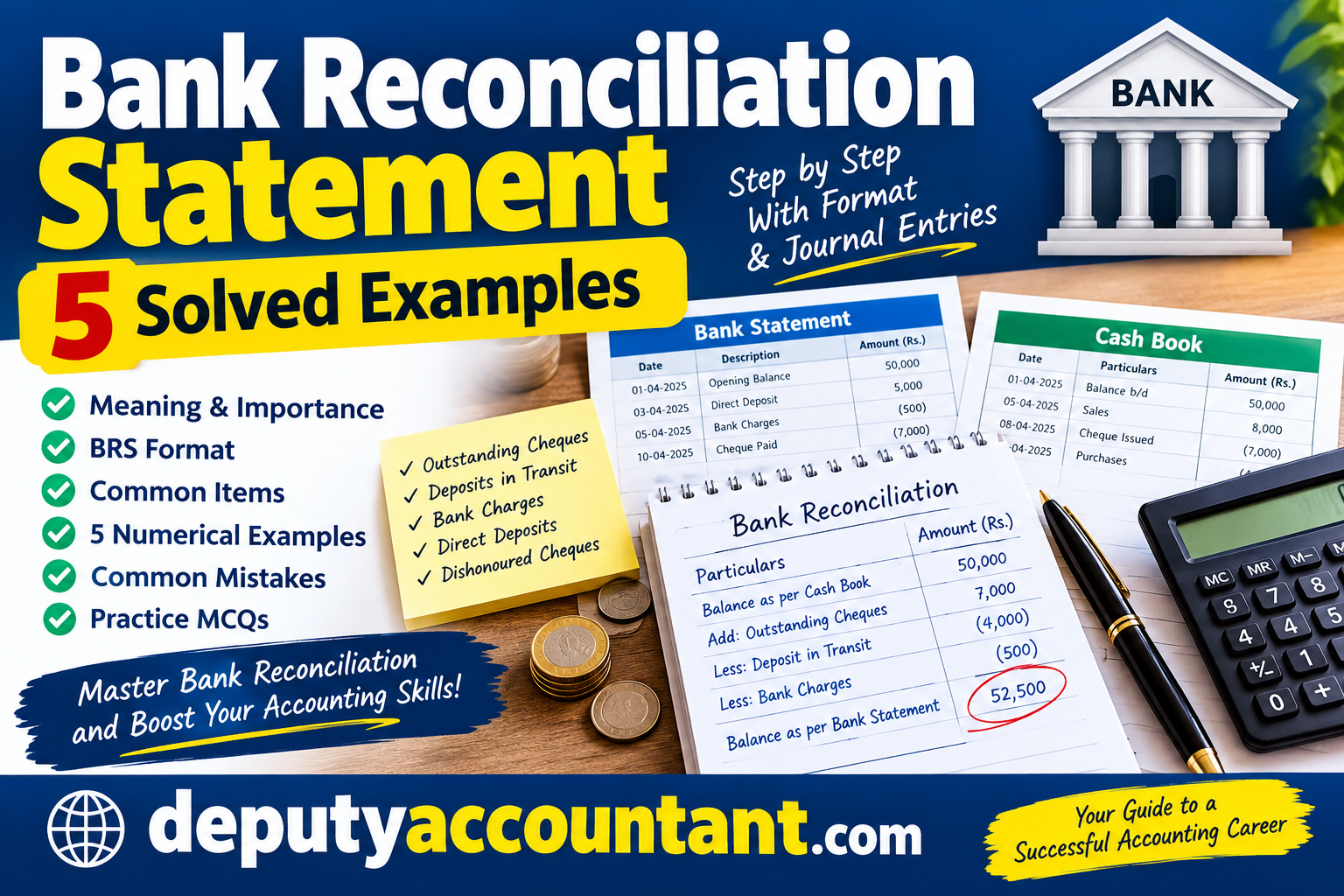
A Bank Reconciliation Statement (BRS) is an accounting statement used to explain the difference between the bank balance shown in a company’s cash book and the balance reported by its bank statement. It helps identify outstanding cheques, deposits in transit, bank charges, direct deposits, and other transactions that may not have been recorded in both records at the same time.
For accounting students, finance professionals, and candidates preparing for accounting examinations, understanding bank reconciliation is an important practical skill. This guide explains the meaning of a BRS, its format, the treatment of common transactions, and five solved examples with step-by-step calculations.
What Is a Bank Reconciliation Statement?
A Bank Reconciliation Statement is prepared to reconcile the bank balance recorded in the cash book with the balance appearing in the bank statement for the same date.
The two balances may differ because some transactions are recorded in one set of records before the other. For example, a business may record a cheque payment immediately, but the bank may deduct the amount only when the cheque is presented for payment.
A BRS helps an accountant investigate these differences and determine whether adjustments or further investigation are necessary.
Why Is Bank Reconciliation Important?
Preparing a BRS can help a business:
- Identify differences between its accounting records and bank records.
- Detect bank charges or direct deposits that have not yet been recorded in the cash book.
- Identify outstanding cheques and deposits in transit.
- Find possible recording errors or unauthorized transactions.
- Maintain more accurate cash and bank balances.
Bank reconciliation should be performed regularly, commonly every month, or more frequently when transaction volumes require it.
Bank Reconciliation Statement Format
A simple BRS may be prepared using the following format:
| Particulars | Amount (Rs.) |
|---|---|
| Balance as per cash book | 50,000 |
| Add: Deposit recorded in cash book but not yet credited by bank | 8,000 |
| Less: Cheque issued but not yet presented | (5,000) |
| Adjustments for other reconciling items | As applicable |
| Balance as per bank statement | 53,000 |
This example assumes that the starting balance is a favourable cash-book balance and that the listed transactions are the only differences.
Important: The direction of an adjustment depends on the starting balance and the nature of the transaction. Always identify whether you are starting from the cash-book balance or the bank-statement balance.
Also Read More: Deputy Accountant Job Duties, Responsibilities and Career Growth in Punjab
Common Items in Bank Reconciliation
1. Outstanding Cheques
An outstanding cheque is a cheque recorded as a payment in the cash book but not yet presented to the bank.
When starting with a favourable cash-book balance, an outstanding cheque is generally added to reach the bank-statement balance because the bank has not yet deducted the payment.
2. Deposits in Transit
A deposit in transit is an amount recorded as a receipt in the cash book but not yet credited by the bank.
When starting with a favourable cash-book balance, a deposit in transit is generally deducted to reach the bank-statement balance because the bank has not yet added the deposit.
3. Bank Charges
Banks may deduct service charges directly from an account. If the business has not recorded these charges, the cash book must be updated.
When starting from the unadjusted cash-book balance, bank charges are deducted.
4. Direct Deposits
Customers may deposit money directly into a company’s bank account. If the deposit appears in the bank statement but has not been recorded in the cash book, the cash book must be updated by adding the receipt.
5. Dishonoured Cheques
A cheque received from a customer may be returned unpaid by the bank. If the receipt was already recorded in the cash book, the business must reverse or adjust the receipt when notified of the dishonour.
Five Solved Bank Reconciliation Examples
The following are original educational examples using hypothetical transactions. Each example states its starting point and assumptions to make the calculations easier to follow.
Example 1: Outstanding Cheque
Question: A business has a favourable cash-book balance of Rs. 40,000. Cheques issued amounting to Rs. 6,000 have not yet been presented to the bank. Assume there are no other differences. Calculate the bank-statement balance.
Solution:
Starting balance as per cash book = Rs. 40,000
Add: Outstanding cheques = Rs. 6,000
Bank-statement balance = Rs. 40,000 + Rs. 6,000
Answer: Rs. 46,000
Explanation: The business has already recorded the cheque payment, but the bank has not yet deducted it. Therefore, the bank-statement balance remains higher than the cash-book balance.
Example 2: Deposit in Transit
Question: The cash book shows a favourable bank balance of Rs. 25,000. A deposit of Rs. 4,500 has been recorded in the cash book but has not yet been credited by the bank. Assume there are no other differences. Find the bank-statement balance.
Solution:
Starting balance as per cash book = Rs. 25,000
Less: Deposit in transit = Rs. 4,500
Bank-statement balance = Rs. 25,000 − Rs. 4,500
Answer: Rs. 20,500
Explanation: The cash book includes the deposit, but the bank has not yet credited it. Consequently, the bank-statement balance is lower.
Example 3: Bank Charges Not Recorded in the Cash Book
Question: The unadjusted cash book shows a favourable bank balance of Rs. 32,000. The bank statement includes service charges of Rs. 750 that have not been recorded in the cash book. No other differences exist. Calculate the adjusted cash-book balance.
Solution:
Unadjusted cash-book balance = Rs. 32,000
Less: Bank charges = Rs. 750
Adjusted cash-book balance = Rs. 32,000 − Rs. 750
Answer: Rs. 31,250
Explanation: The bank has already deducted the service charges. The business must record the expense in its cash book to bring its records up to date.
Journal entry:
Bank Charges Expense Dr. Rs. 750
To Bank Rs. 750
Example 4: Direct Deposit and Bank Charges
Question: The unadjusted cash-book balance is Rs. 18,000. A customer has deposited Rs. 5,000 directly into the bank account, while the bank has deducted charges of Rs. 300. Neither transaction has been recorded in the cash book. Calculate the adjusted cash-book balance.
Solution:
| Particulars | Amount (Rs.) |
|---|---|
| Unadjusted cash-book balance | 18,000 |
| Add: Direct deposit | 5,000 |
| Less: Bank charges | (300) |
| Adjusted cash-book balance | 22,700 |
Calculation:
Rs. 18,000 + Rs. 5,000 − Rs. 300 = Rs. 22,700
Answer: Rs. 22,700
Explanation: The direct deposit increases the bank balance, while the service charges reduce it. Both transactions must be recorded in the cash book.
Example 5: Preparing a Bank Reconciliation Statement with Multiple Items
Question: A business has a favourable cash-book balance of Rs. 50,000. The following differences are identified:
- Cheques issued but not presented: Rs. 7,000
- Deposit recorded in the cash book but not yet credited by the bank: Rs. 4,000
- Bank charges not recorded in the cash book: Rs. 500
Assume there are no other differences. Calculate the bank-statement balance.
Step 1: Adjust the cash book
The bank charges have already been deducted by the bank but are missing from the cash book.
Adjusted cash-book balance:
Rs. 50,000 − Rs. 500 = Rs. 49,500
Step 2: Prepare the reconciliation
| Particulars | Amount (Rs.) |
|---|---|
| Adjusted cash-book balance | 49,500 |
| Add: Cheques issued but not presented | 7,000 |
| Less: Deposit in transit | (4,000) |
| Balance as per bank statement | 52,500 |
Answer: Rs. 52,500
Explanation: The outstanding cheques increase the bank-statement balance relative to the cash book. The deposit in transit reduces it relative to the cash book. The bank charges are first recorded in the cash book because they have already been deducted by the bank.
How to Prepare a Bank Reconciliation Statement Step by Step
Follow this process when solving a BRS question:
- Identify the starting balance and determine whether it is from the cash book or bank statement.
- Check whether the starting balance is favourable or an overdraft.
- List all transactions that appear in one record but not the other.
- Separate timing differences from errors and omitted transactions.
- Adjust the cash book for bank charges, direct deposits, interest, dishonoured cheques, and any verified cash-book errors.
- Reconcile the adjusted cash-book balance with the bank statement using outstanding cheques, deposits in transit, and other valid reconciling items.
- Investigate any remaining unexplained difference rather than forcing the figures to agree.
Common Bank Reconciliation Mistakes
Mistake 1: Using the Wrong Sign
Adding an item that should be deducted is a common source of incorrect answers. Always identify the starting balance before deciding the treatment.
Mistake 2: Ignoring the Overdraft
An overdraft is not the same as a favourable bank balance. The reconciliation treatment must be reconsidered when the starting balance is an overdraft.
Mistake 3: Confusing Timing Differences with Errors
Outstanding cheques and deposits in transit may simply reflect timing. However, an incorrect amount, duplicate entry, or missing transaction may require correction.
Mistake 4: Forgetting to Adjust the Cash Book
Bank charges, direct deposits, bank interest, and dishonoured cheques often require cash-book adjustments if they have not already been recorded.
Mistake 5: Treating Reconciliation as Proof That Everything Is Correct
Even when the balances agree, errors may remain undetected. Reconciliation is a control procedure, not a guarantee that fraud or every accounting mistake has been found.
Practice MCQs on Bank Reconciliation
Test your understanding with these original practice questions.
Question 1: A cheque issued has been recorded in the cash book but has not been presented to the bank. When starting from a favourable cash-book balance, how is this item generally treated?
A. Deduct it
B. Add it
C. Ignore it in every case
D. Record it as bank income
Correct answer: B. Add it.
Explanation: The bank has not yet deducted the cheque payment, so the bank-statement balance is generally higher than the cash-book balance by this amount.
Question 2: The bank deducts service charges of Rs. 400 that are not recorded in the cash book. What adjustment is required?
A. Increase the cash-book balance by Rs. 400
B. Decrease the cash-book balance by Rs. 400
C. Increase sales by Rs. 400
D. No adjustment is needed
Correct answer: B. Decrease the cash-book balance by Rs. 400.
Explanation: The bank has already deducted the charges, so the cash book must record the expense.
Question 3: The cash book records a deposit of Rs. 3,000 that has not yet appeared in the bank statement. When starting from a favourable cash-book balance, how is the deposit generally treated in the reconciliation?
A. Add Rs. 3,000
B. Deduct Rs. 3,000
C. Deduct Rs. 6,000
D. No adjustment is ever required
Correct answer: B. Deduct Rs. 3,000.
Explanation: The cash book already includes the receipt, but the bank has not yet credited it.
Frequently Asked Questions
What is the main purpose of a Bank Reconciliation Statement?
Its main purpose is to explain differences between the cash-book bank balance and the bank-statement balance and help identify missing entries, timing differences, and possible errors.
Is a Bank Reconciliation Statement a journal entry?
No. A BRS is a reconciliation statement. However, transactions missing from the cash book may require journal entries or other appropriate bookkeeping adjustments.
How often should a business prepare a BRS?
Many businesses prepare bank reconciliations monthly. Businesses with high transaction volumes or stricter control requirements may reconcile more frequently.
Does a BRS detect every accounting error?
No. It can help identify discrepancies but does not guarantee that every error, fraudulent transaction, or omission will be detected.
Can bank reconciliation questions appear in accounting examinations?
Bank reconciliation is a fundamental accounting topic and is useful for practice. Candidates should check the official syllabus for their specific examination rather than assume that a topic is guaranteed to appear.
Conclusion
A Bank Reconciliation Statement helps businesses maintain accurate bank records and investigate differences between their cash books and bank statements. By practising outstanding cheques, deposits in transit, bank charges, direct deposits, and combined reconciliation questions, students can build a stronger understanding of the process.
For examination preparation, practise each transaction separately before attempting questions with multiple reconciling items. Always check the starting balance, apply the correct treatment, and verify the final calculation.